
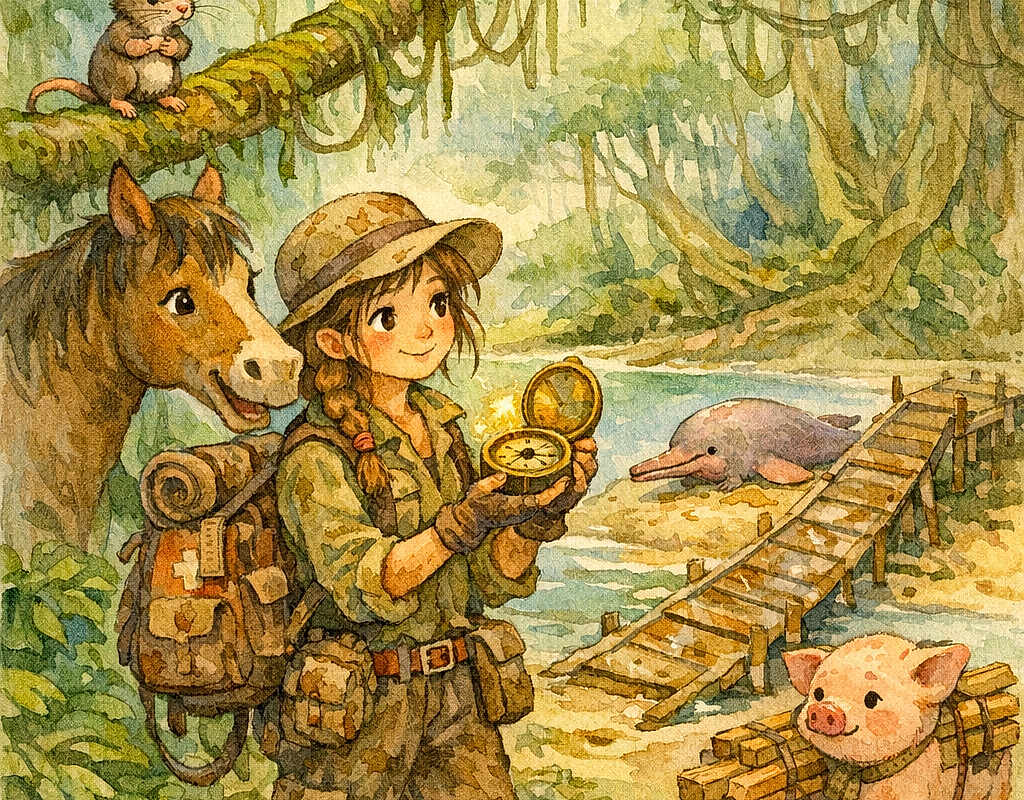
Aurelia the Vet had a rule she tried to follow, even in places that made her feel small: listen first, act second, and only panic third.
She was a girl with a sun-browned nose, a backpack full of neatly labeled bandages, and a habit of talking to animals the way other kids talked to best friends. She wasn’t the kind of hero who swung swords or shouted speeches. Aurelia was quieter than that—careful, observant, a little shy when strangers stared. But when an animal needed help, her shyness folded up like a map and tucked itself away.
The Amazon was not a tidy place for maps.
The river looked like a moving road of bronze, reflecting clouds that boiled and drifted above the canopy. The air smelled like wet leaves, fruit so ripe it was almost fermented, and the sharp green bite of sap. Every few steps, something hissed, clicked, croaked, or whirred. Aurelia had come with a small research boat and a team of adults, but she’d wandered away from the camp’s neat line of solar lanterns to check a rumor the boat guide had mentioned.
“There’s a place,” he’d said, eyes serious, voice lowered like the forest might overhear, “where the old animals go when they can’t walk far anymore. Not a grave. A resting place. And some say there’s a spring there that can heal the heavy kind of hurt.”
Aurelia didn’t believe in magical springs. Not exactly.
But she did believe in overlooked places and forgotten creatures.
Now she stood under a cathedral of branches, ferns brushing her knees, and wondered whether she had walked into someone else’s secret.
A soft thud came from behind a tree with buttress roots like giant folded hands.
Aurelia froze. “Hello?”
Something snorted.
Then, from the shadowed tangle, a horse stepped out.
A horse. In the Amazon.
He was tall and dappled, his coat the color of storm clouds with flecks like silver dust. Vines had snagged in his mane. His eyes were intelligent, wary, and frankly annoyed—as if he’d been dealing with foolish humans for centuries.
Aurelia took a slow breath, keeping her hands visible. “Easy. I’m Aurelia. People call me Aurelia the Vet.”
The horse flicked an ear. His gaze swept her backpack and lingered on the stethoscope looped around the strap.
“You smell like clean cloth and worry,” a voice said.
Aurelia blinked.
The voice came again, lower this time, and the horse’s mouth moved just slightly.
Aurelia did not scream. She did not faint. She did, however, forget the correct scientific explanation for anything.
“You… talk,” she managed.
The horse lowered his head until his breath warmed her knuckles. “You understand. That’s different.”
Aurelia swallowed. “I… I listen,” she said, because it was the truth. “Sometimes I understand. What’s your name?”
The horse lifted his chin as if he were being introduced at a fancy event. “Mistral.”
“Mistral,” Aurelia repeated. “Are you hurt?”
Mistral’s nostrils flared. “Not me.”
He turned and began walking, not fast, but with the certainty of someone who expected to be followed. Aurelia hesitated. Going farther from camp was against every sensible instruction she’d been given.
But Mistral’s words—Not me—tugged at the part of her that could not ignore need.
She followed.
The forest shifted as they moved. The light grew greener and dimmer. The air cooled in patches, then warmed again, like stepping through invisible curtains. Aurelia had to push aside long palm fronds, and once she had to duck beneath a fallen tree whose underside was bright with mushrooms like tiny lanterns.
A small shape darted along a branch above her.
“Careful,” Mistral said without looking back.
Aurelia looked up and saw a mouse—except not a tiny, timid house mouse. This mouse had glossy brown fur and bright eyes like polished seeds. It ran with the confidence of a creature who had never once been shooed away from a kitchen.
The mouse skidded to a stop on the branch and stared down at Aurelia.
“You’re late,” the mouse squeaked.
Aurelia stared back. “Excuse me?”
The mouse scurried down the trunk in a spiraling blur and landed on a root near Aurelia’s boot. It put its paws on its hips, a gesture that somehow looked perfectly natural.
“Mistral said he’d find someone with hands that heal,” the mouse said. “And here you are, with your big bag and your bigger expression.”
“My expression?” Aurelia repeated.
The mouse pointed a tiny paw at Aurelia’s face. “That one. Like you’re trying to decide if you’re dreaming. Stop it. We don’t have time.”
Mistral snorted, a sound that might have been laughter. “Aurelia, this is Pita.”
“Pita,” Aurelia echoed.
Pita bowed with dramatic flair. “Navigator, collector of rumors, and the only creature here with enough sense to bring snacks.”
From somewhere in the leaves, a rustling sounded like a person wading through paper.
A pig emerged.
Aurelia had to blink twice again because the Amazon kept behaving like a place that didn’t care about her expectations. This pig was round, mud-splattered, and wearing what looked suspiciously like a woven leaf harness with pockets. In one pocket was a curled vine. In another, something shiny.
The pig’s eyes were gentle and a little sad, as if it had seen too many animals limp away alone.
“This is Tambo,” Mistral said.
Tambo gave a quiet oink and then, to Aurelia’s shock, spoke in a deep, slow voice. “Hello, healer girl.”
Aurelia’s heart thumped hard. She forced herself to focus on the important part. “You said someone is hurt.”
Pita’s ears drooped. “Not hurt like a scratch.”
Tambo nodded. “Sick like a story that’s gone wrong.”
Mistral’s tail swished. “Come.”
They led Aurelia off the faint trail and into a pocket of forest that felt hidden. The trees grew in a wide circle, their trunks braided with vines, their roots rising like steps. In the center was a shallow clearing with a stone basin half-filled with rainwater and fallen petals.
And beside the basin lay an animal.
It was a river dolphin—pink and pale, its skin dulled, breathing in thin, uneven pushes. Aurelia recognized it instantly from pictures, but seeing it here, far from the river, was like seeing a cloud on the ground.
Aurelia dropped to her knees. “Oh no. How did you get here?”
The dolphin’s eye rolled toward her. It looked exhausted.
Pita hopped onto a root and wrung its paws. “We found her near the bank. She was trapped in a net. We got her out, but she’s… she’s not right.”
Tambo snorted softly. “Her breathing is wrong. Her skin is dry. She doesn’t want water.”
Aurelia opened her backpack with quick, practiced movements. The forest noises felt muted, as if everything nearby was holding its breath.
She checked the dolphin’s skin and eyes, spoke softly, listened with her stethoscope. She didn’t need to understand dolphin language to understand distress.
“She’s dehydrated,” Aurelia said. “And she’s stressed. She should be in the river, but moving her might…” She paused. “You said you know a spring.”
Mistral’s ears tilted forward. “Not a spring. A tree.”
Pita’s whiskers twitched. “The Old One. Deep in the shade. It makes water taste like the beginning of the world.”
Aurelia stared at them. “You mean… a specific tree?”
Tambo nodded. “A tree that keeps a medicine in its heart. Not magic exactly. Just… older than our worry.”
Aurelia thought of all the medicines that came from plants, all the compounds still unnamed. The Amazon wasn’t a fairy tale; it was a living library. Maybe this was simply a page she hadn’t read.
“All right,” Aurelia said. Her voice shook a little, but her hands were steady. “We need to keep her moist and calm. And we need to get that medicine water.”
Pita pointed at Aurelia’s backpack. “You have cloth.”
Aurelia pulled out sterile gauze and a light blanket. “We’ll use these. Mistral, can you help carry? Tambo, can you find clean leaves to shade her?”
Mistral stepped close, lowering himself in a careful bend. “I can carry you. Not the dolphin.”
Aurelia frowned. “Then how do we move her?”
Tambo rummaged in his harness pocket and pulled out the curled vine. “We weave.”
Pita’s eyes brightened. “Yes. A sling. Like for fruit.”
Aurelia blinked at the pig and mouse speaking like a rescue team. “You’ve done this before.”
Tambo’s expression turned even gentler. “We try.”
They worked together. Aurelia guided the process, tying knots with quick fingers, using vines and broad leaves, reinforcing with the blanket. Mistral pressed his shoulder against a fallen log to steady it. Pita darted around collecting the best flexible stems, chattering instructions like a tiny foreman.
“Not that one—itchy! That one—strong! Don’t tie it like a shoelace, tie it like you mean it!”
Aurelia found herself smiling in spite of the worry.
When the sling was ready, they slid it beneath the dolphin with slow care, keeping her skin damp with water from the basin. Tambo and Mistral took the front ends of the sling, and Aurelia took the side, supporting the dolphin’s weight while Pita ran ahead, squeaking directions.
“Left at the tree that looks like it’s dancing!” Pita called.
Aurelia panted. “They all look like they’re dancing!”
“Then pick the one with the sassiest roots!” Pita replied.
Even Mistral made a sound that might have been a chuckle.
They traveled through a corridor of deeper shade. The forest here smelled different—less fruit, more damp stone. The air felt like it had been waiting.
After what felt like an hour but might have been only twenty minutes, the ground rose gently. A slope led them to a massive tree whose trunk was so wide Aurelia couldn’t have hugged even a tenth of it. The bark was smooth in places, ridged in others, and etched with lines that looked almost like writing.
At the base of the trunk, a hollow formed a natural bowl. Inside it, clear water pooled, trembling with tiny ripples although nothing touched it.
Pita approached the bowl with unusual reverence. “Old One,” the mouse whispered.
Tambo bowed his head. Mistral went still.
Aurelia felt a prickle along her arms. Not fear—something like respect, but sharper.
She knelt beside the bowl and dipped a finger in the water. It was cool, but not cold. It smelled faintly of mint and rain.
She lifted her gaze to the dolphin, whose breathing had become more shallow.
“All right,” Aurelia murmured. “Let’s help you.”
She soaked gauze and gently dabbed the dolphin’s skin. She used a small syringe without a needle to offer water at the corner of the dolphin’s mouth, slow and careful so she wouldn’t aspirate. She spoke quietly, the way she did with frightened animals back home.
“It’s okay. You’re safe. We’re here. You don’t have to fight alone.”
Mistral watched her with steady eyes. “You don’t speak loud. But you speak true.”
Aurelia didn’t look up. “My teachers say calm is a tool. Animals can feel it.”
Pita sniffed. “Humans rarely bring calm. Mostly they bring buckets and opinions.”
Tambo rumbled softly. “Aurelia brings hands that listen.”
The dolphin’s eye blinked, slow and deliberate. Her mouth shifted, not quite a smile, but less tense.
Aurelia continued for several minutes, then paused to listen again with her stethoscope. The dolphin’s breathing had steadied slightly. Not cured—healing wasn’t a switch you flipped—but improved.
Relief loosened something in Aurelia’s chest.
“We need to keep doing this,” she said. “But she also needs the river. She needs to float. Her body isn’t meant to lie on land long.”
Pita’s ears drooped again. “The river is far.”
Mistral stamped once, impatient. “Not too far for me.”
Aurelia frowned. “Even if you carry me, we still have to carry her.”
Tambo’s harness pockets rustled as he shifted. “We can build a slide.”
“A slide?” Aurelia repeated.
Tambo nodded. “We use big leaves. Smooth bark. We make a path that glides. We do not lift the whole way.”
Pita perked up. “Yes! Like sending a watermelon down a hill. Only… more polite.”
Aurelia looked around. The slope from the Old One tree led down toward the direction they’d come from. If they could create a slick, supported path, they could move the dolphin with less strain.
“Okay,” Aurelia said. “We’ll need the right leaves. No sharp edges. And we need to keep her wet the whole time. We’ll work fast.”
They became a team with a single purpose. Aurelia directed, but she also followed—because in this forest, Pita knew what plants burned and which ones soothed, and Tambo knew how to weave and brace. Mistral used his strength to drag smooth fallen branches into place and press them flat.
As they worked, Aurelia noticed something else: the carved lines on the Old One’s bark seemed to catch the light differently, as if the tree held a pattern meant to be read.
She leaned closer and traced one with her finger.
Pita noticed. “Don’t get distracted. The dolphin needs you.”
“I know,” Aurelia said. “I just… what are these?”
Mistral’s ears angled back. “Marks of promises. Long ago, animals came here to drink when the river was sick. They promised to protect the places that heal.”
Tambo added, voice low, “Some promises were kept. Some were forgotten.”
Aurelia’s throat tightened. She thought of nets in water, plastic on shores, engines too loud, forests cut into squares.
“We can keep one,” she said quietly.
Pita’s whiskers twitched. “Humans?”
Aurelia nodded once. “At least this human.”
The slide-path took shape. Broad leaves overlapped like shingles, glossy side up. Smooth bark pieces formed rails. Vines tied everything so it wouldn’t shift.
When they were ready, Aurelia checked the dolphin again. Her breathing was steadier now, and her eye followed Aurelia’s movements.
“All right,” Aurelia said, trying to sound confident. “We’re going to move you. It might feel strange, but we’ll be careful.”
They positioned the sling onto the slide and began guiding it down the slope. The dolphin glided slowly, supported and shaded. Aurelia ran alongside, wetting gauze and pouring water gently over the dolphin’s skin.
Pita sprinted ahead, squeaking warnings. “Root! Left! Watch that stick! Tambo, your knot is slipping—no, it’s not, I just wanted to say something important!”
“Pita,” Aurelia called, breathless, “is that important thing helpful?”
Pita hesitated. “It is important for morale.”
Mistral snorted again.
They reached the lower ground and continued toward the river. The forest opened slightly, and humid air thickened with the scent of water.
Then a problem arrived—not as a villain with a cape, but as a simple, unfair fact.
A fallen tree blocked the narrow channel they needed to cross. Behind it, the ground dipped into a muddy basin. The easiest path was gone.
Aurelia stared at the obstacle. “We can’t lift her over.”
Mistral pawed the ground. “We go around.”
Pita climbed onto the log and peered over. “Around is longer. She’s tired.”
Tambo sniffed the air, ears drooping. “Longer might be too long.”
Aurelia’s mind raced. No antagonist, no monster—just the forest being wild and indifferent.
Listen first, act second, panic third.
She put a hand on the fallen log and examined it. It was thick but rotting in places, softened by fungus. The mud basin on the other side looked shallow.
“What if we slide under?” she said.
Pita’s eyes widened. “Under?”
Aurelia nodded. “We dig a shallow trench beneath the log, just enough to pull the sling through. The log stays. We go beneath it.”
Mistral blinked slowly. “Clever.”
Tambo’s snout lifted. “We can dig.”
Pita wrinkled its nose. “I have tiny paws, but I will contribute with enthusiasm.”
They worked quickly. Tambo used his strong snout like a shovel, pushing mud aside. Mistral scraped with his hooves carefully, avoiding the sling. Aurelia used a small trowel from her medical kit—meant for cleaning hooves or clearing debris—and widened the trench.
Pita darted in and out, removing small stones, then squeaked, “I am basically a bulldozer!”
Aurelia, sweating and muddy, laughed. “A very small bulldozer.”
When the trench was ready, they eased the sling forward. It slid through, barely clearing the log. The dolphin’s body stayed supported, and Aurelia kept her skin wet.
On the other side, the air smelled strongly of river. The sound of water—moving, living—grew louder.
They emerged onto a bank where the brown river curled around a bend, edged with reeds. Sunlight struck the surface in shards.
Aurelia’s chest filled with relief. “We made it.”
They lowered the sling carefully into the shallows. Water lapped against the dolphin’s skin, and immediately her breathing eased. She gave a small, powerful flex of her tail.
Aurelia steadied her, then loosened the sling.
The dolphin floated free.
For a moment she stayed close, her eye meeting Aurelia’s as if memorizing her face. Then she swam forward, slow at first, then faster, cutting the river with a clean line.
Pita wiped its nose with both paws. “Don’t cry,” it muttered. “It makes your whiskers wet.”
Aurelia looked down. She was crying a little, though she hadn’t noticed until Pita said it.
Tambo exhaled deeply. “Good.”
Mistral stood tall, watching the river. “The river keeps her now.”
Aurelia wiped her cheeks with the back of her muddy wrist. “Thank you,” she said to all of them. “You saved her. You found her. You didn’t give up.”
Pita sniffed. “We did not do it alone. Humans usually do things alone and then complain about it.”
Aurelia smiled. “I complain too.”
“That’s fine,” Pita said. “But you also acted.”
They stood quietly as the dolphin disappeared around the bend. The forest sounds returned, as if someone had turned the volume back up.
Then Tambo nudged Aurelia’s backpack gently with his snout. “You came for rumor.”
Aurelia nodded. “I did.”
“And you helped,” Mistral said.
Pita’s eyes gleamed. “Which means… you’re ready.”
“Ready for what?” Aurelia asked.
Pita hopped onto a rock near the water’s edge. “For the reward.”
Aurelia blinked, startled into a laugh. “A reward?”
Tambo nodded solemnly. “For keeping promises. The Old One does not pay with words alone.”
Aurelia followed them back along the bank to a place where tree roots formed a natural arch over the mud. Beneath the arch, half-hidden, was something that did not belong to the river: a small chest made of dark wood, bound with metal that had turned green with time.
Aurelia’s breath caught. “Is that… real?”
Pita rubbed its paws together. “Real enough. We can’t open it. No thumbs. It is our greatest tragedy.”
Mistral added dryly, “Pita has tried chewing.”
“I did not chew,” Pita protested. “I tested the texture.”
Tambo’s eyes softened. “The chest came downriver long ago. It caught under these roots. We kept it safe. We waited for someone who would not take without giving.”
Aurelia knelt. The chest was heavy. The lock was old but intact.
“I… I don’t want to steal,” Aurelia said.
Pita waved a paw. “It’s not stealing if the forest gives it.”
Mistral nodded. “Open it. And remember the marks of promises.”
Aurelia placed her fingers on the lock and examined it the way she examined injuries: patiently, respectfully. The metal had a simple mechanism, the kind that could be coaxed rather than broken.
From her kit, she took a small tool used for delicate work—thin, sturdy. She slid it into the lock and listened.
Click.
The sound was tiny, but it echoed in Aurelia’s mind like a door opening in a quiet house.
She lifted the lid.
Inside, cushioned in dried leaves, lay objects wrapped in oilcloth: a brass compass etched with unfamiliar symbols, a small carved bone whistle, and a pouch of seeds so black they looked like pieces of night.
Aurelia lifted the compass first. It was cool and surprisingly clean. The needle inside did not point north. It swung slowly, then settled, pointing toward the interior of the forest.
Pita leaned in, eyes shining. “That compass does not find places. It finds needs.”
Aurelia stared. “Finds… needs?”
Tambo nodded. “It points to creatures who are lost or hurt. To places where help is required.”
Mistral’s voice grew softer. “A healer’s compass.”
Aurelia’s heart thudded with something like awe and responsibility. She imagined returning to her camp with this, using it to locate injured animals, to guide rescues, to prove to skeptical adults that the forest still held secrets worth protecting.
She picked up the whistle. It was carved with tiny wave patterns.
Pita squeaked, “That calls friends when the jungle is too loud. Not monsters. Friends.”
Aurelia tried to picture it—sending a clear note through the tangled world.
Then she touched the pouch of seeds.
Tambo’s voice warmed. “Plant those near clean water. They grow fast. They feed many.”
Aurelia looked from the treasure to her three companions. “Why give this to me?”
Mistral met her gaze. “Because you did not ask what you would get. You asked what you could do.”
Pita added, as if correcting him, “Also because you have thumbs.”
Aurelia laughed, and this time it came out steady.
She wrapped the compass, whistle, and seeds carefully and placed them in her backpack. The weight felt different now—less like equipment, more like a promise.
“Will I see you again?” she asked.
Tambo stepped closer, mud squelching softly. “If you follow the compass with a kind heart, you will be in the same story we are.”
Pita nodded vigorously. “Also, come back with snacks. Real snacks. Not leaves. I am brave, but I am not unreasonable.”
Mistral lowered his head so Aurelia could rest her hand on his forehead. His coat was warm, alive.
“You were shy,” Mistral said, “but you did not hide.”
Aurelia swallowed. “Sometimes I hide when it’s about me. I don’t hide when it’s about them.”
Mistral’s ear flicked. “Then you are exactly the kind of healer the forest needs.”
Aurelia turned toward the direction of camp. Somewhere beyond the trees, adults would be searching for her, probably worried, probably angry. She would face that. She would explain—carefully, honestly—and maybe they wouldn’t believe everything.
But she had proof: mud on her knees, a steadier confidence in her chest, and a compass that pointed toward need.
Before she left, Aurelia pulled out a small notebook and, with a pen that still worked despite the humidity, she wrote a single sentence on the first page:
Listen first. Act second. Panic third.
Then, beneath it, she added:
And never go alone when teamwork can carry the weight.
Pita read the words upside down and said, “Good. Now write: ‘Bring snacks.’”
Aurelia grinned. “Second page.”
She stepped back into the forest path. The compass in her backpack gave a faint, steady pressure, like a finger pointing.
Behind her, at the river’s edge, Tambo, Pita, and Mistral watched until the green swallowed her.
And far downriver, where the water curved like a ribbon through endless trees, a pink dolphin rose once, breathed, and slipped beneath the surface—alive, free, and carrying the story forward.