
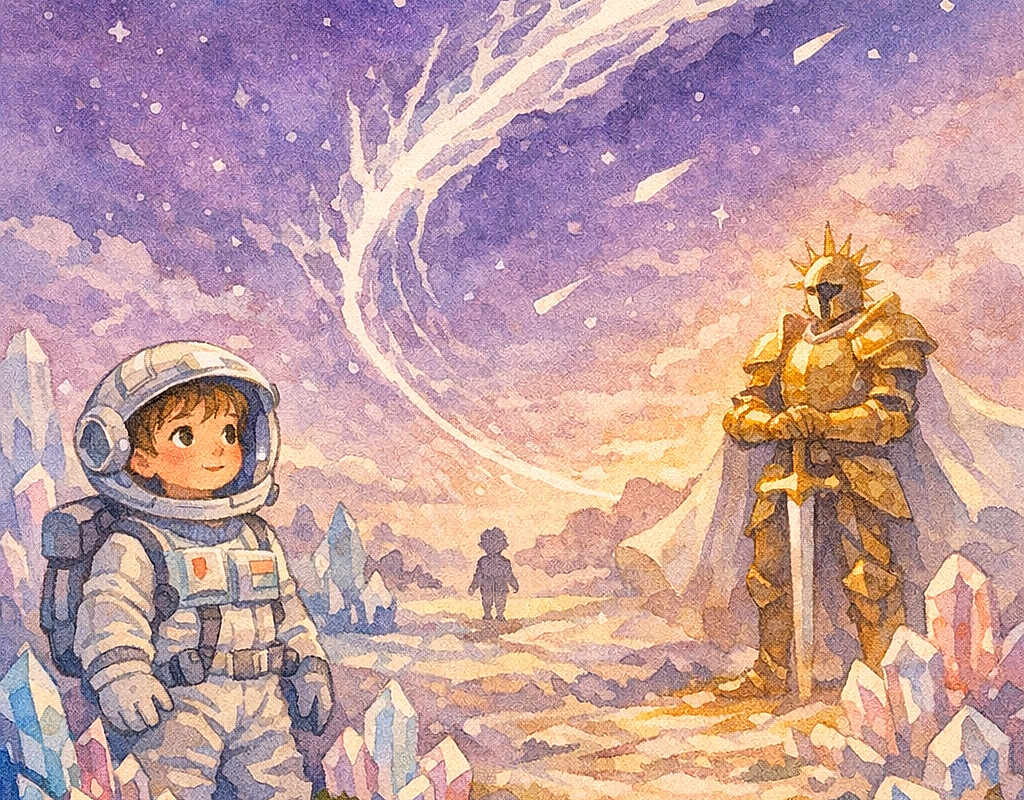
Curtis James had trained for years to be an astronaut, but he still felt a strange flutter in his stomach every time a hatch sealed and the air turned quiet. He was brave in the way a person can be brave while admitting, honestly, that the universe is enormous and that your own heartbeat can sound too loud inside a helmet.
His friends at Mission Control liked to tease him about his careful habits.
“Curtis,” the flight director would say, “you’ve checked the oxygen valves three times.”
Curtis would answer, “Yes, and the fourth check is for my peace of mind.”
That was his special kind of courage: the courage that brought a checklist into the unknown.
On the day his ship, the Lark, left orbit and angled toward the deep black between worlds, Curtis carried one more secret habit. He always kept a small silver coin in a pocket of his suit. It wasn’t lucky in a magical way, but it was heavy, real, and familiar, like a promise that some things could be held.
His destination was a lonely planet on the edge of mapped space. It was officially labeled K-412, but the astronauts who’d only scanned it from far away called it the Hush Planet, because its surface reflected so little signal that it seemed to swallow sound.
A few weeks earlier, telescopes had noticed something odd above K-412: the starfield behind it looked scratched, as if invisible hands had dragged a finger through the night. Then came the real mystery—an emergency ping, faint and rhythmic, rising from the planet’s dark side.
The message was short, almost shy.
HELLO.
CAN YOU HEAR ME.
I AM LOST.
Curtis read those words again and again. Lost could mean a ship. Lost could mean a person. Lost could mean something no one at Mission Control had a name for.
So Curtis James went.
The descent took him through thin gray clouds that looked like ash but tasted, on his filters, like clean stone. Beneath them, the planet spread out in soft layers: glassy plains, ridges like frozen waves, and clusters of pale crystals that caught what little light there was and returned it in quiet, careful glimmers.
“Landing sequence stable,” Curtis reported.
His voice sounded calm, but his hands were steady because he made them steady—he pressed his fingers to each control in order, the way he’d practiced.
The Lark touched down with a puff of dust that rose, hesitated, and fell like tired snow.
Curtis stepped onto the surface.
It was colder than he expected, not the kind of cold that bites, but the kind that makes everything feel farther away. His boots made no crunch. The ground held him without a sound, as if the planet preferred to keep its thoughts inside.
“Okay,” Curtis whispered, and immediately felt silly, because his mic sent his whisper into his ear at normal volume. “Okay, Curtis. Find the source of the ping. Offer help. Don’t panic if the planet tries to… I don’t know. Be a planet.”
A faint glow pulsed ahead, low to the ground.
He followed it, guided by his wrist display and by a strange sense that the glow was also watching him.
The terrain dipped into a bowl-shaped valley. In its center stood a ring of crystals, taller than Curtis, arranged like a small city of transparent towers. The pulsing light came from within the ring.
Curtis approached carefully.
The crystals hummed—not in his ears, but in his bones, like an idea trying to become a sound.
Then a figure stepped out from behind the tallest crystal.
At first Curtis thought it was another astronaut, because the figure was roughly human-sized and wore something like a suit. But the suit was made of moonlight: thin, silvery layers that drifted as if underwater. The figure’s face was visible, pale and bright, with large dark eyes that reflected the stars.
The figure tilted their head.
“You heard,” the figure said.
The voice was soft, and Curtis realized the words were arriving not through radio, but through the gentle vibration of the crystals around them.
Curtis lifted a hand, palm out, a gesture of peace he hoped was universal.
“I heard you,” he said. “I’m Curtis James. I’m an astronaut from Earth.”
The figure blinked slowly.
“Earth,” they repeated, tasting the word. “I am Moon Child.”
Curtis had expected fear or confusion from whoever sent the message. Moon Child looked neither frightened nor confused—only intensely curious, like someone who had been waiting for a door to open and was relieved it finally did.
“You said you were lost,” Curtis said. “Are you alone here? Did you crash?”
Moon Child stepped closer. Their feet didn’t quite touch the ground; they hovered a finger’s width above it.
“Not crash,” Moon Child said. “I… slipped.”
Curtis frowned. “Slipped from where?”
Moon Child looked up, and the crystals around them brightened.
“From the Moon Roads,” Moon Child said.
Curtis glanced at the sky. The stars were sharp, but he saw no roads.
Moon Child’s eyes softened, as if they could see Curtis’s doubt.
“You don’t see,” they said. “That’s normal for your kind. The Moon Roads are the paths between light and shadow. I traveled them. Then the Sun Knight chased, and the road broke. I fell here.”
Curtis knew how to deal with broken equipment, not broken roads made of light. Still, he’d learned in astronaut training that the unknown was best approached with questions, not arguments.
“The Sun Knight chased you?” Curtis asked.
Moon Child’s expression tightened.
“He guards brightness,” Moon Child said. “He says the Moon Roads belong to the Sun. He says I steal moonbeams.”
Curtis looked down at the crystal ring.
“And you’re stuck on this planet because the road broke,” he said.
Moon Child nodded. The hum in the crystals shivered.
“I called,” Moon Child said. “But signals are swallowed. You came anyway.”
Curtis felt an unexpected warmth at that. Someone had reached out, and he had answered. It made the emptiness of space feel slightly less empty.
“I came,” he agreed. “So let’s figure out how to get you home. First, we should find out what’s happening with the ‘scratched starfield’ we saw from far away. That might be connected.”
Moon Child’s eyes widened. “You saw the scratches?”
“Yes,” Curtis said. “Like the sky is torn.”
Moon Child pressed their palms to a crystal. The crystal lit up, projecting a thin arc of light across the valley—like a ribbon pulled tight.
“The road broke,” Moon Child whispered. “It’s still bleeding light. That makes scratches.”
Curtis stared at the arc. It wavered, flickering, as if it might snap.
“If the Moon Road is unstable,” Curtis said slowly, “it could be dangerous. For you, for this planet, maybe even for my ship. We need to repair it.”
Moon Child looked pleased. “Repair,” they echoed. “Yes. That’s the word.”
Curtis took a breath. His heart tried to speed up; he slowed it with a familiar trick: name the steps.
Step one: understand the problem.
Step two: gather resources.
Step three: test solutions.
“What do we need?” Curtis asked.
Moon Child pointed toward the far side of the valley. In the dim distance rose a range of cliffs that looked almost black, except for tiny specks of shining dust drifting upward like sparks.
“Moonbeams,” Moon Child said. “Gathered and woven. But the beams are scattered. The Sun Knight pushed them into the Shadow Canyons.”
Curtis followed the direction with his gaze.
Shadow Canyons sounded like the kind of place that would make Mission Control tell him to wait for backup. But there was no backup in this part of space. There was only him, his ship, and a hovering child of moonlight.
“All right,” Curtis said. “We’ll gather the moonbeams. Then we’ll see if we can weave them into… a patch.”
Moon Child’s mouth curved in what might have been a smile.
“Patch,” they repeated, delighted. “Like cloth.”
Curtis checked his suit systems, then opened a compartment on his belt and pulled out a small sample container.
“I have these,” he said. “They’re designed for collecting dust, crystals, small rocks. If moonbeams behave like particles, maybe we can trap them.”
Moon Child leaned close to inspect the container. Their hair—if it was hair—flowed like thin mist.
“You are clever,” Moon Child said.
Curtis felt his ears heat inside his helmet. “I’m… cautious. Cautious is a kind of clever.”
They set off toward the cliffs.
As they traveled, the planet unfolded in quiet wonders. The ground changed from smooth glass to a field of crystal needles that chimed softly when Curtis’s boots brushed them. Moon Child floated ahead, occasionally tapping a crystal spire so it flashed a brief pattern, like a greeting to the next formation.
Curtis began to realize the planet wasn’t silent. It simply spoke in delicate ways: in light, in vibration, in the tiny shifts of dust.
After an hour they reached the edge of the Shadow Canyons.
The cliffs dropped sharply into a maze of narrow passages. Darkness pooled between the stone walls, but it wasn’t empty darkness. It moved, slowly, like thick ink.
Curtis’s suit lamp cut a bright cone ahead. The darkness recoiled from the light, then crept forward again when the beam passed.
Moon Child hovered beside Curtis, their glow steady.
“The canyons hold what falls,” Moon Child said. “Light falls too.”
Curtis swallowed. “We’ll move carefully.”
They descended into the canyon.
The air—thin as it was—felt heavier down here. Curtis’s lamp reflected off the walls, revealing carvings that looked like old maps: spirals, crescents, and lines that curved like orbits.
“Did you make these?” Curtis asked.
Moon Child traced a carving with one finger.
“Not me,” they said. “Older. The planet remembers.”
A faint glimmer appeared ahead—tiny threads of silver floating just above the ground.
Moon Child gasped softly. “Moonbeams.”
Curtis crouched, holding the sample container open.
The moonbeams drifted like slow fireflies without bodies, reluctant to be captured.
“Easy,” Curtis murmured, as if speaking to nervous animals. He adjusted the container’s magnetic rim, then activated a gentle suction.
The threads shivered, then slid into the container like silk pulled through a ring.
A soft chime sounded from inside, and the container’s interior glowed.
“It worked,” Curtis said.
Moon Child clapped silently, their hands meeting without sound but with a flash of light.
They moved deeper into the canyon, collecting more moonbeams. Curtis filled one container, then a second, then a third. Each time, the soft chimes grew louder.
Then the darkness ahead thickened.
Curtis’s lamp beam seemed to bend, as if the air itself didn’t want light to pass.
Moon Child froze.
“He’s near,” Moon Child whispered.
Curtis’s stomach fluttered again. “The Sun Knight?”
Moon Child nodded.
A sudden gleam appeared at the far end of the passage—golden, fierce, like sunrise compressed into a blade.
Out of the darkness stepped a tall figure in armor that looked hammered from sunlight. His helmet was shaped like a flame. In his hand he carried a spear whose tip burned without smoke.
Even though Curtis’s suit protected him, he felt the heat reach his skin like a memory.
The Sun Knight’s voice rang like metal struck hard.
“Moon Child,” he said. “You spill stolen light across a quiet planet. You call strangers to help you hide.”
Moon Child floated closer to Curtis, as if Curtis were a shield.
“I did not steal,” Moon Child said. “I traveled. The road broke because you chased.”
The Sun Knight’s spear flared brighter.
“The Moon Roads belong to order,” he declared. “Light must move as it is commanded. You wander, you tangle paths, you tempt shadows to rise.”
Curtis lifted his hands, palms open.
“I’m not here to fight,” Curtis said. “I’m here to repair what’s broken. Those scratches in the sky could be dangerous for everyone. Including you.”
The Sun Knight turned his helmet toward Curtis.
“A mortal in a shell of glass and air,” he said. “You do not understand.”
Curtis’s fear tried to become panic. He pushed it down with a thought: I have handled emergencies in training. I have practiced calm.
“I understand repairs,” Curtis said. “And I understand that chasing someone until a road breaks is not the same as keeping order.”
The Sun Knight stepped forward. The canyon walls lit with harsh gold.
“You carry moonbeams in your containers,” the Sun Knight said. “Return them.”
Moon Child’s glow dimmed. “Those are mine to go home,” they whispered.
Curtis’s mind raced. He couldn’t outfight a being made of sunlight. But he could outthink a confrontation.
He glanced at the carvings on the wall: crescents, spirals, orbit lines.
“Wait,” Curtis said quickly. “If your job is order, then you must respect rules. The planet’s rules, too.”
The Sun Knight paused.
Curtis pointed to the carvings. “These look like a map. This canyon is part of an older system. Maybe the planet itself holds the Moon Roads’ anchor points. If we damage them, you’ll lose control entirely.”
The Sun Knight’s burning spear lowered a fraction.
Moon Child looked at Curtis with surprise, as if they hadn’t considered the planet could have a say.
Curtis continued, choosing each word as if it were a tool.
“I propose a contest,” he said. “A friendly one. If we can stabilize the broken road and stop the scratches, you let Moon Child return safely. If we fail, I will return the moonbeams and leave. No more wandering, no more calls.”
The Sun Knight’s armor crackled.
“A contest,” he repeated. “On what terms?”
Curtis’s heart hammered. He was making this up, but it was the only path he saw that didn’t involve heat and harm.
“On precision,” Curtis said. “We both want the sky to be intact. Let’s see who can restore it more cleanly. You provide your sunlight to seal the tear. We provide moonbeams to weave the patch. If the repair holds for one full rotation of the planet—one day—then the solution is sound. If it fails, you win.”
Moon Child whispered, “One day is long.”
Curtis whispered back, “Long enough to prove it works.”
The Sun Knight stood still. The canyon seemed to wait with him.
Finally he said, “Very well. But I will watch. And if you trick me, I will burn your little ship into a warning.”
Curtis forced himself to nod calmly. “Understood.”
Moon Child leaned close. “You are either very brave,” they murmured, “or very foolish.”
“Sometimes,” Curtis whispered, “those two look identical.”
They climbed out of the canyon and returned to the crystal ring in the valley.
The Sun Knight followed, striding across the planet’s surface as if he owned the horizon. Wherever he stepped, the crystals caught his light and flashed sharply, turning the soft landscape into something bright and severe.
At the ring, Moon Child placed their hands on the tallest crystal. Curtis set the glowing containers at the base, arranging them like a careful scientist setting up an experiment.
“Explain how weaving works,” Curtis said.
Moon Child closed their eyes.
“Moonbeams are gentle,” they said. “They bend, they join, they forgive mistakes. Sunlight is strict. It makes edges. It reveals.”
The Sun Knight snorted. “It makes truth.”
Curtis ignored the insult.
“So we need both,” Curtis said. “Moonbeams for flexibility, sunlight for sealing.”
Moon Child nodded. “Yes. Like stitches and glue.”
Curtis opened the first container. Moonbeams rose in thin spirals, circling Moon Child’s hands. Moon Child began to move their fingers through the air, drawing the threads into a lattice.
The lattice shimmered, forming a translucent sheet.
Curtis watched, amazed, then remembered the practical problem.
“How do we get that sheet up to the tear in the sky?” he asked.
Moon Child hesitated.
“The tear is above the planet,” they said. “It floats where the road broke.”
Curtis looked toward his ship on the plain.
“I can fly the Lark under it,” Curtis said. “Maybe the ship’s field can carry the patch.”
The Sun Knight’s helmet turned sharply.
“You would bring your metal insect into the Moon Roads?” he demanded.
“It’s not an insect,” Curtis muttered, then spoke louder. “It’s designed to navigate space. If the tear is in near orbit, I can reach it. But I’ll need guidance. Moon Child, can you sense it?”
Moon Child’s eyes opened, reflecting the stars.
“I can feel it,” they said quietly. “It aches.”
They lifted the woven sheet of moonbeams. It hovered above their palms like a fragile net.
Curtis ran back to the Lark, moved by urgency and by the fear that if he took too long the Sun Knight would decide to end the contest early.
Inside the ship, Curtis strapped in, hands moving fast but precise. He powered up, checked thrusters, stabilized systems. His coin pressed against his pocket, reminding him of weight and home.
Moon Child floated into the airlock, their moonbeam net held carefully.
They didn’t need a suit. They didn’t seem to need air.
The Sun Knight stood outside, watching through the ship’s window, a golden statue of impatience.
Curtis lifted off.
The planet dropped away beneath him, the crystal valley shrinking into a faint sparkle.
Moon Child hovered beside Curtis’s seat, watching the displays as if they were star charts.
“Higher,” Moon Child said, voice soft through the ship’s speakers. “To the place where the night stings.”
Curtis followed the guidance, ascending into a darker layer of sky where the stars seemed to tremble.
Then he saw it.
The tear was not a hole but a seam ripped open, a jagged line where the black of space looked frayed. Light leaked from it in thin, curling scratches.
Curtis’s mouth went dry.
“If that grows,” he said, “it could mess with gravity, radiation—everything.”
Moon Child nodded, their expression solemn.
“We must soothe it,” they said.
Curtis maneuvered the Lark until it hovered near the tear. The ship’s stabilizers hummed, fighting invisible currents.
Moon Child raised the moonbeam net. It fluttered, pulled toward the tear like fabric toward a thorn.
Curtis activated the ship’s external field generator, normally used to stabilize delicate satellite repairs. A faint blue halo formed around the Lark.
The net steadied.
“Now,” Moon Child whispered.
They pushed the net forward.
It stretched, thinning as it met the jagged seam, then began to spread across it, threads linking to the frayed edges.
For a moment, it looked like it might hold.
Then the tear pulsed.
A surge of harsh brightness flared from below—Sun Knight’s sunlight, stabbing upward like a spear.
Curtis’s instruments spiked.
“Sun Knight!” Curtis shouted into the comm. “Not yet! You’ll burn the weave!”
The sunlight hit the moonbeam net.
Instead of burning, the net flashed, and the threads tightened, forming a stronger pattern—like cold metal hardened by heat.
Moon Child gasped, eyes wide.
“It… it works together,” they said.
Curtis exhaled shakily. “Good. Great. Please keep working.”
The net sealed more of the tear, but a gap remained at the center, where the seam still bled scratchy light.
Moon Child’s hands trembled.
“I don’t have enough,” they admitted. “We need more moonbeams.”
Curtis glanced at the containers still sealed on the floor of the ship. “We have more. Use them.”
Moon Child opened the second container, drawing the threads out with a gesture. They wove quickly now, sweatless but strained, like someone trying to mend a sail in a storm.
The tear resisted.
Curtis felt the ship shudder as if the seam tugged on it.
“Curtis,” Moon Child said urgently, “the tear is hungry. It pulls on anything that touches it.”
Curtis looked at the ship’s field readouts. The stabilizer was near its limit.
If it failed, the Lark could be dragged into the tear. He pictured the ship stretched like taffy, scattered into light.
He thought of Earth, of Mission Control, of the coin in his pocket.
Then he made a decision that felt like stepping off a ledge.
He unstrapped.
Moon Child stared. “What are you doing?”
“I’m going outside,” Curtis said.
“That is… a terrible idea,” Moon Child said, with the blunt honesty of someone who didn’t do polite lies.
Curtis grinned, nervous. “Yes. But I can anchor the net manually and relieve strain on the field. I’ve done EVA repairs before.”
Moon Child’s glow flickered with worry.
Curtis pulled on his helmet, sealed his suit, and entered the airlock.
When the outer hatch opened, space wrapped around him—silent, endless, and sharp.
He tethered himself to the Lark and pushed off.
The tear loomed ahead like a wound in the night.
Moon Child’s voice came through the suit comm. “Be careful. The tear will try to take your thoughts, too.”
“My thoughts are mostly checklists,” Curtis said. “It’s welcome to them.”
He reached the edge of the moonbeam net. The threads vibrated under his gloved fingers.
Curtis pulled a tool from his belt: a compact grappling clamp designed to grip rock in microgravity.
He clipped the clamp onto a thick cluster of moonbeam threads, then anchored the other end to the ship’s frame.
The net steadied.
He added a second clamp, then a third, creating a triangle of tension that distributed the pull.
Inside the ship, Moon Child wove the final threads toward the center gap.
“Now,” Moon Child breathed. “Sun Knight, shine.”
The sunlight surged again, but this time it was controlled, less like a spear and more like a beam from a lighthouse.
It struck the center.
The moonbeams tightened, the seam’s frayed edges drew together, and with a sound Curtis felt in his chest rather than heard, the tear closed.
The scratched starfield smoothed.
The night became normal again—vast, but no longer wounded.
Curtis hung in space for a second, staring.
“It’s… beautiful,” he whispered.
Moon Child’s voice was thick with relief. “The road is whole.”
Below, the planet turned quietly.
Curtis returned to the airlock, shaking from adrenaline and cold. When he came back into the cabin, Moon Child hovered close.
“You risked yourself,” Moon Child said.
Curtis shrugged, trying to look casual while his heart raced. “It was the quickest fix.”
Moon Child tilted their head. “You are brave in a strange way. Like a door that opens even when it creaks.”
Curtis laughed. “I’ll take that.”
They descended back to the crystal valley.
The Sun Knight waited, arms crossed, his armor still bright but less aggressive now. The crystals around him glowed softly, as if relieved to return to gentle light.
Curtis stepped out of the Lark and walked toward him with Moon Child at his side.
“The tear is sealed,” Curtis said.
The Sun Knight looked up at the sky. The scratches were gone. For the first time, his spear’s flame dimmed to a steady glow.
“You have skill,” he admitted. It sounded almost painful for him to say.
Moon Child lifted their chin. “And you have strength. But you used it like a chase. Strength can also guard.”
The Sun Knight’s helmet turned toward Moon Child.
“You tangled the roads,” he said.
Moon Child’s voice softened. “I wandered, yes. I was curious. I wanted to see new skies. But I did not mean harm.”
Curtis stepped between them, sensing the old argument trying to restart.
“The contest terms were one rotation,” Curtis reminded. “If the repair holds, Moon Child goes free.”
The Sun Knight’s spear tapped the ground once, sending a ring of gold light through the crystals.
“It will hold,” he said, as if he could already feel the steadiness of the sealed seam. “Very well. Moon Child may return.”
Moon Child’s glow brightened so much that Curtis had to squint.
“But,” the Sun Knight added, “the Moon Roads are not toys. If you travel them again, you will travel with rules.”
Moon Child considered, then nodded. “I will travel with care.”
Curtis watched them, surprised. It wasn’t a surrender. It was an agreement.
The Sun Knight turned to Curtis.
“And you,” he said. “You interfered in a matter of celestial order.”
Curtis straightened. “I repaired a dangerous tear. That seems like good order to me.”
For a long moment, the Sun Knight studied him.
Then, to Curtis’s shock, the Sun Knight reached to his chest plate and pulled free a small object: a shard of solid sunlight, shaped like a thin hexagon. It glowed, but it didn’t burn.
“A token,” the Sun Knight said grudgingly. “For the one who mended what should not have broken. It is called a Sun Seal. It will power one machine without fuel for a long time.”
Curtis’s eyes widened. He took it carefully in his gloved hand. It felt warm and steady, like holding a tiny sunrise that had learned patience.
“This is… incredible,” Curtis said.
Moon Child clapped again, flashing light in celebration.
“You get treasure,” Moon Child said. “Humans like treasure.”
Curtis laughed. “We do. But mostly we like not dying.”
The Sun Knight’s stance relaxed slightly. “You did not die. That is also order.”
Moon Child drifted upward, toward the tallest crystal.
“The Moon Road will open here,” they said. “The ring is an anchor.”
They placed their hands on the crystal, and the ring began to glow in a pattern—crescent shapes cycling like phases.
A ribbon of silver light appeared above the ring, arcing into the sky.
Curtis stared. Now that he knew what to look for, he could see it: a path made of pale radiance, leading upward and away, curving toward distant space.
Moon Child looked down at Curtis.
“Curtis James,” they said, “you came when I called. If you ever feel lost in the dark between worlds, listen. The Moon Roads hum. I will hum back.”
Curtis felt an unexpected tightness in his throat.
“I’ll remember,” he said. “And if you ever need a checklist, I have plenty.”
Moon Child laughed—a sound like soft chimes.
Then they rose, following the silver path, their body blending with the light until they were a moving gleam among the stars.
The ribbon faded behind them, leaving the crystal ring quiet again.
Curtis turned to the Sun Knight.
“So,” Curtis said, choosing his words, “are we… done?”
The Sun Knight looked at the calm sky.
“We are balanced,” he said. “For now.”
With that, he lifted his spear. A flare of gold light wrapped around him, and he vanished upward like a sunbeam returning to its source.
Curtis stood alone in the valley, the planet’s hush settling around him.
He walked back to the Lark and climbed inside.
At Mission Control, static crackled, then cleared.
“Lark, this is Control. We saw the starfield distortion vanish. Report.”
Curtis looked at the Sun Seal in his hand, then at the sealed sky beyond the window.
“Report,” Curtis said. “The tear is repaired. The planet is stable. And I have… an energy artifact. It can power the Lark’s systems for months.”
A long pause.
Control finally said, “An artifact.”
Curtis smiled to himself. “Yes. Also, there was a Moon Child.”
Another pause.
Control said, very carefully, “Copy that, Curtis. We’ll… add it to the log.”
Curtis laughed softly.
He secured the Sun Seal in a padded case, then checked his fuel, his oxygen reserves, and his navigation.
Before takeoff, he pulled the silver coin from his pocket and set it beside the Sun Seal.
Old weight and new light.
He realized something then: bravery wasn’t the absence of fear. It was the decision to do careful work even when fear tried to shake your hands.
Curtis launched from the Hush Planet and rose into the repaired night.
The stars were steady, no longer scratched.
And as the Lark sailed toward home, Curtis could almost imagine, far beyond the edge of his instruments, a soft humming—like moonlight traveling a road that only appeared once you believed it could exist.
He didn’t tell Mission Control about the humming. Some things were allowed to stay a little mysterious.
But he did keep the Sun Seal.
Back on Earth, weeks later, engineers would stare at it under microscopes and whisper excitedly about new kinds of power. Curtis would be asked to give speeches, to pose for pictures, to explain how it felt to stand near a tear in the sky.
And every time, Curtis James would say the same honest thing:
“It felt scary,” he would admit. “But I had a job to do, and I wasn’t alone.”
In his locker at the space center, he would keep the Sun Seal in a case that glowed faintly at night, and next to it the old silver coin.
A treasure and a reminder.
And sometimes, when the building was quiet and the world outside his window looked like a dark ocean, Curtis would listen very carefully.
Somewhere, impossibly far away, a Moon Road might be humming back.